Set Her Free

I've found myself in a most toxic relationship
She wakes up each morning 
Eager to fulfill my dreams
A thankless role she plays
The recipient of an endless onslaught
of judgment, criticism, and disappointment
Often cruelly starved
of love and appreciation
of human kindness
And yet I know she'll cling with every last breath
I know she will not leave
Compliments, praise, adoration from passersby
Never quite filling the void of affection
From the one who matters most 
I watch myself belittle and degrade her
I see myself compare her to every woman on the street
Observing this treatment of women by anyone else
Lights a fire of rage within me

Somehow those standards crumble 
When applied to the heartbreak at my own hand
I know it's not about her
My anger, sadness, and fear
They're all my own
Why can't I love her the way I'm supposed to?
I know we're destined to be
She was designed just for me 
I've found myself in a most toxic relationship
I'll spend my life trying to set her free
My body deserves nothing but love from me

Own It

Joe Biden and Kamala Harris are all but declared the President- and Vice President-Elect of the United States. This moment is a complex whirl of emotions and reflections for many of us, as we celebrate a victory, mourn many losses (economic, viral, and political), and reconcile with the reality that our country is much more deeply divided than we wanted to admit. Instead of throwing victory parties, for many this is a moment of silence, and not necessarily because COVID-19 inhibits us from embracing each other with joy. With the sigh of relief comes a pit in our stomachs as we look out at all the work ahead of us.

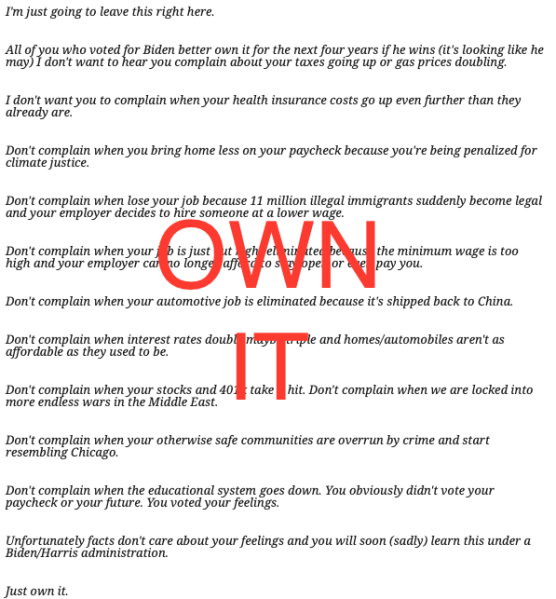
As always, many of us are taking to the internet to share our thoughts as Election Day (read: Week) winds down. A statement is going around reflecting a Trump supporter’s condemnation of Biden voters in light of the impending election results. As it truly made me think, and I took it to heart, I feel it warrants a response. Let’s go line-by-line. (original post in red)

I’m just going to leave this right here. All of you who voted for Biden better own it for the next four years if he wins (it’s looking like he may) I don’t want to hear you complain about your taxes going up or gas prices doubling.

There are two possible interpretations of this introduction. The first would be that the author is speaking to the very privileged and wealthy demographics in our nation, as those are the only groups (those who make over $400k/year) whose taxes even have the potential of changing under Biden. Though this does not include me, I can firmly say that those are prices I’m willing to pay. Had I voted to (fallaciously) keep my taxes low or to suppress gas prices, I would be telling you the price I’ve put on human rights. On decency. At second glance, I’m aware that the author may misunderstand or, more likely, be misrepresenting Biden’s economic policies and thus be attempting to address Biden voters in their entirety. In this case, it is essential to reiterate that these claims are simply baseless. The fear-mongering that Trump has employed to scare people into thinking they can’t afford to live in Biden’s America is a political tactic as old as time. The aim is to make us fear for ourselves, our families, and our livelihoods. To scare us into voting. To inhibit us from voting for the betterment of our nation by making us fear for our own survival.

I don’t want you to complain when your health insurance costs go up even further than they already are.

It is a fundamental tenet of the Democratic platform to make health care more accessible. Though we don’t all agree on the right way to do that, it is at minimum a conversation we refuse to stop having. Trump had no health care plan. Under a Trump administration, my family was at serious risk of losing healthcare, as were millions of others. If you voted on health care, you voted for Biden.

Don’t complain when you bring home less on your paycheck because you’re being penalized for climate justice.

On this argument, I reference my first response. There are some things in this world for which there is a price I am willing to pay. Climate justice and sustainability fall into that category. The short-sided and selfish nature of the argument that we should sacrifice the environment, our children’s planet, and the livelihoods of the marginalized communities beings severely impacted by climate change to save a few cents on the dollar is mind-boggling. Moreover, the overwhelming evidence falls on the side of sustainability and the green energy revolution being the basis for driving economic growth in the long-term.

Don’t complain when lose your job because 11 million illegal immigrants suddenly become legal and your employer decides to hire someone at a lower wage.

This response is painfully ignorant of the realities of our immigration system and the way it interacts with our economy. Our immigrant workforce drives prosperity in this nation. Not only does their legal participation in the economy increase tax revenue and the flow of money, but they most frequently take the jobs that Americans aren’t willing to. Most often, immigrants put more into our economy than they take, as they often aren’t able to take advantage of many of our social services. Even more, immigrants are a critical component of the diversity of thought and perspective that perpetuates the innovation and advancements that keep this country on the forefront of progress and prosperity. All of that aside, at a fundamental, human level, it goes against the basic principles of America’s creation to turn away those seeking betterment and opportunity.

Don’t complain when your job is just out right eliminated because the minimum wage is too high and your employer can no longer afford to stay open or even pay you.

Despite this point’s implicit contradiction with the prior statement that employers will be hiring newly legalized immigrants for cheap, short-term job loss is an incomplete assessment of minimum wage increase. First and foremost, the industries in which low-wage jobs are concentrated are traditionally some of the fastest growing sectors in our economy. A common misunderstanding on the topic of minimum wage surrounds who is employing these workers and will thus be most impacted. The vast majority of minimum wage workers are actually employed by large corporations, not small businesses. These are corporations who can afford the pay increase, have traditionally taken advantage of workers at the bottom, and consistently compensate executives and shareholders disproportionately. Yes, there is potential for a minimum wage increase to initially eliminate some jobs; however, it puts more money in the hands of more Americans who, in turn, perpetuate the economy and drive growth at a higher rate than if we were to continue concentrating the wealth with the top executives.

Don’t complain when your automotive job is eliminated because it’s shipped back to China.

Explicitly outlined in Biden’s platform is his plan to penalize American companies for moving jobs overseas. Of the two candidates in question, Trump poses a much larger threat to Americans in the form of frighteningly friendly relationships with some countries, like China, and his apparent desire to benefit their leaders and economies.

Don’t complain when interest rates double maybe triple and homes/automobiles aren’t as affordable as they used to be.

Let’s get one thing straight: homes aren’t affordable and haven’t been for some time. Many millennials and Gen Z’s are reconciling the fact that home ownership, a traditional pillar of the American Dream, may be out of the question for us. However, an increase in wages and a commitment to providing the necessities of health care and education would put a lot of us much closer to that dream. Further, Biden’s commitment to tackling COVID head-on and getting the economy back on track provides a better outlook for those of us trying to make those big investments. As for the claim that interest rates will double or triple under Biden, there is quite simply zero evidence to believe that will be the case, especially in this unprecedented time of recession and pandemic. In fact, as part of Biden’s plans to pay specific attention to race in his quest for economic recovery, he has outlined how there may actually be good reason to hold interest rates lower for longer due to the disproportionate impact on Black communities.

Don’t complain when your stocks and 401k take a hit. Don’t complain when we are locked into more endless wars in the Middle East.

Looking specifically at the most likely outcome of this election, we know that, historically, the stock market actually performs best under a Democratic president and a Republican senate. Moreover, there is negligible correlation between the party in the White House and the performance of the economy. As for foreign policy, Biden ran on plans to end wars in the Middle East and continue investment in our military.

Don’t complain when your otherwise safe communities are overrun by crime and start resembling Chicago.

The claim that Trump’s America is safer than Biden’s America could only possibly hold true in a world in which Trump continues to incite violence and encourage chaos upon his defeat. In reality, I feel much safer about my life as a woman in a diverse city with a history of crime (Washington, D.C) under a Democratic president. Police reform is beyond necessary, and many Democrats would argue defunding would actually be more effective. However, the argument is not for national free-for-all. In place of our law enforcement institutions, rooted in minority suppression, racial discrimination, and state-sponsored violence, many of the proposed alternatives involve community-oriented programs with specific emphasis on effectively addressing the problems we face. For example, investing in education and intervention resources for domestic violence, funneling money into rehabilitation, and eliminating the guns on our streets are only a few of the proposals. It is not just about eradicating the system, it is about replacing the system – changing the way we think about crime, safety, and community; creating new infrastructure for keeping our citizens safe; and developing institutions that protect all Americans. Most importantly, the law enforcement reform policies go hand-in-hand with the liberal platform as a whole. By decriminalizing drugs, making health care accessible, expanding education, funding community services, and empowering racial minorities, we eliminate so much of the threat at the source. All of that said, it is worth remembering that Biden is actually quite moderate when it comes to police funding. Much to the chagrin of more bullish liberals, he has refused to commit to any defunding, so Trump supporters can sleep soundly.

Don’t complain when the educational system goes down. You obviously didn’t vote your paycheck or your future. You voted your feelings.

It is unclear why or how the author thinks the educational system is going down, especially given that Democrats are more likely to invest in public education, make college affordable, and provide alternative schooling opportunities. However, yes, I did vote my feelings. I voted policies and principles and platforms. But I also voted my feelings. I voted hope and unity and decency. I voted equality and empathy and empowerment. I voted that gut feeling that made me cringe and fear for myself and my neighbors each time Trump took to Twitter and his supporters took to the streets. I voted the overwhelming optimism of our young progressives standing up for what is right. I voted Biden.

Unfortunately facts don’t care about your feelings and you will soon (sadly) learn this under a Biden/Harris administration. Just own it.

After 4 years of Republicans turning a blind eye to Trump’s antics, it’s a bit comical to ask us to own anything. However –

I own it. I own every morsel of what my vote stands for. I own it proudly.
Tests, Trump, and Tactics

Professor Nicholas Didow of Kenan-Flagler Business School requested on the midterm exam for his Global Marketing class that students address an article in The Economist titled America’s New Business Model in the form of a letter to the Editor. Inspired by the relevance and applicability of this academic endeavor, I thought it pertinent to share what I would say to the Editor and, should he be willing to listen, to Trump:

Dear Editor:

I agree with the general premise of this article: Trump’s promises and policies are contradictory, short-sighted, and politically savvy.

President Trump’s brilliance lies in his ability to monopolize global attention with the grandiose declaration of promises that appeal to the underinformed citizen whose short-term time horizon favors quick-fixes and drastic measures. Often criticized by opponents for his lashing out on social media and attacks on corporate leaders, Trump has successfully convinced the American public that he will be their economic advocate without yet having to incur any of the costs or losses of political capital should he actually implement all-encompassing policy measures.

There is no mystery to the appeal of Trump’s economic policies to the American workforce. Despite the notable improvements made during the last administration, the nation is still very much so recovering from economic turmoil, and the memory is fresh in the minds of constituents. Playing to the desire for job security and global competitiveness is a safe political move. His tactics, though, do not account for the long-term need for labor force adaptation and the danger of political unpredictability. By demonizing any firm that looks abroad, Trump effectively bolsters American elitism and isolationism, undermining what may have been opportunities to better serve the American consumer. His promise of tariffs on goods produced elsewhere takes a protectionist economic tool designed to differentiate between the corporations of different nations and transforms it into a mechanism for internal conflict and nepotism as well, heightening the potential disadvantageous effects. For a leader who praises capitalism and old-fashioned hard work, his interventionist tendencies and erratic actions counteract the market forces at play. This isolationism is increasingly detrimental when the modern global socio-political climate is taken into account; the largest threats facing society include violent non-state actors, the collective action problem presented by climate change, and the international automation of operations. These obstacles will require collaboration, cooperation, and commitment.

Neorealist thought, championed by Kenneth Waltz, suggests that the state’s main purpose and function is to maintain security. Protectionism appears to be a mechanism for guaranteed security, as it eliminates the possible entry of an external threat; however, a new threat can emerge from within, as efficiency, opportunity, and competition suffer from manufactured constraints. Contrarily, a highly-competitive global marketplace may simultaneously seem to facilitate security, especially in the form of power. If a nation is able to generate competitive advantages and increase efficacy, the bargaining power, relationships, and wealth generated can act as means for reinforcing domestic security. Unfortunately, intense competition in a globalized and inequitable world presents the potential for international threats and disputes.

Any ideology in excess presents dangers; both the 11/9 (openness from the fall of the Berlin Wall) and 9/11 (isolation from a devastating act of international terror) mindsets have detrimental capacity if implemented to the extreme or in a vacuum. This logic materializes in the election of government officials, such as President Trump. The commonplace bipolar political spectrum exhibits strength in its potential to offer checks and balances and demonstrates risks with the ability for extremists on either end to acquire power. It is a widely-held belief that a moderate approach is often most lucrative and desired. Protectionism at its purest decreases the quality of life and the opportunities domestically in the long-term; however, an element of protectionism may be necessary, especially as an economy transitions (for example, from one rooted in agrarian activities to an industrialized, capital-intensive marketplace) and the labor force adapts. Likewise, complete openness and exchange, as exemplified by the fall of the Berlin Wall, presents challenges as well, such as the short-term exploitation of lesser developed communities due to their lack of regulation and bargaining power in the quest for efficiency.

President Trump’s intervention in the market sets a dangerous precedent in which the government, specifically the president, is able to interfere with the economy at any given time, despite the its stable state or any ability to self-regulate. This danger is furthered as the likely negative repercussions from these actions will probably be viewed by the public as the consequences of government action, leading to a negative perception of big government and government intervention in situations when it could, in fact, be quite necessary.

Ironically, his eagerness to initiate protectionist policies and attack businesses’ globalizing activities is in direct combat with his promises to “drain the swamp” and rid the government of the collusion and corruption that has frustrated Americans for so long. By operating with a fear tactic and singling out specific corporations, he is incentivizing companies to appease him and enter into agreements with his administration. Corporations will now prioritize government relations and seek out tight alliances, potentially including positions in the government itself. As noted in The Economist, lobbying will become more influential than ever, making the American democracy less responsive to the constituents than before.

While the predicted material implications of his promised policies are detrimental, these policies do not have to come to fruition for Trump to severely damage the American economic and political system. His antagonistic rhetoric and isolationist behaviors are cultivating the walled-off nation that Friedman discusses emerging from the fear of external threats. The distrust he facilitates between both domestic neighbors and international populations will deprive the United States of valuable alliances, not only in conflict but in knowledge-sharing, innovation, and partnership. The pairing of protectionist policies, which range from physical walls to intangible declarations and are supposed to foster nationalism, with his aggressive demeanor lays the groundwork for internal strife and conflict in a country that will lag behind its global counterparts in quality of life.

Best,

Meredith Freeland


Additional Sources:

The World is Flat- Milton Friedman

Warren J. Keegan and Mark C. Green, Global Marketing, (2017) 9th Edition, Pearson.

More Than a Default Setting

A widespread, and rather convincing, plea for a Clinton vote has been that she is not Donald Trump. Agree or disagree with her policies, Hillary isn’t, as President Obama puts it, a “homegrown demagogue.” However, it is rather unfortunate that a candidate with a résumé more presidential than could be fabricated and policies presented with more clarity than we knew to ask for is being treated as a backup plan. Hillary has no place being the default setting in this election.

It seems most fitting to first speak to the incredible significance of Hillary’s nomination as our first female major party candidate, a feat that has been too frequently overlooked. If the pure symbolic power of her successes aren’t enough, the potential that comes with a woman in this position of leadership gives great hope to those entrusting Hillary with a vote in November. Looking at a period of 20 years, “women won their home districts an average of $49 million more per year than their male counterparts (a finding that held regardless of party, geography, committee position, tenure in office, or margin of victory).” On top of that, women are the answer if we’re looking for change: they “sponsored more bills (an average of three more per Congress), cosponsored more bills (an average of 26 more per Congress), and attracted a greater number of cosponsors than their colleagues who use the other restroom.” Most studies concede that these staggering statistics may not be because women are more competent than men; after all, the argument for women’s rights isn’t that women are superior. However, it is simple fact that to make it in the political sphere, women have to be better. They are scrutinized with more severity, their abilities are always second-guessed, and they are never seen as the typical leader. To be a politician, a woman has to be the best. Time and time again, Hillary has been the best.

Gender aside, Hillary provides a platform that demonstrates tangible benefits for the American workforce. Moody’s Analytics reported that should Hillary’s economic plan be implemented, “the economy would create 10.4 million jobs during her presidency, or 3.2 million more than expected under current law. The pace of GDP growth would also accelerate to an annual average of 2.7%, from the current forecast of 2.3%.” To every resilient American, every family affected by the recession, and every citizen who believes that hard work is the bedrock of this nation, the choice couldn’t be clearer.

If you tuned into the DNC for even a moment, you got a glimpse into Hillary’s qualifications. She’s been in the White House as First Lady and as Secretary of State. She’s been in Congress as a Senator from New York. She fought for our troops on the Armed Forces committee. She’s built up a state during Bill’s time in Arkansas. She’s been on the ground level working for the Children’s Defense Fund.  She knows the plight of high taxes as a wealthy individual. And she knows the hardship of poverty from her mother’s story. There isn’t a piece of our government or sector of our community that Hillary hasn’t interacted with in one way or another.

Part of that impressive résumé has included becoming the face of collaboration, at home and abroad. When looking to foreign policy, international alliances, and a globalizing world, Hillary’s reputation speaks for itself. In a survey of G20 countries, people were asked how they would vote could they participate in the US election: “Hillary Clinton can count on the support of 18 of the world’s 20 leading industrial nations if the world could vote in the 2016 U.S. presidential elections. Republican frontrunner Donald Trump gets top billing from just one country’s people: Russia.” Her experience as Secretary of State fostered strong relationships abroad, especially with our Asian allies who are becoming increasingly important as the global economic epicenter shifts east. Domestically, Hillary has garnered overwhelming support from unexpected leaders. Michael Bloomberg, politically unaffiliated businessman, very publicly endorsed her at the DNC. Executives at Facebook, Google, AT&T, and General Motors, among many others, have expressed their explicit support, as well. In a surprising, but warranted, turn of events, a Democratic candidate is finding friendship in the corporate sector.

While other candidates have lashed out to public criticism with offensive, divisive tweets or frantic press conferences overflowing with horrendous rhetoric, Hillary shows us respect even when we don’t reciprocate it. Throughout each scandal, each (often unfair) media attack, Hillary exhibits grace and a calm, collected temperament. In her DNC nomination acceptance speech, she assured us that she will be a champion for every American: those who vote for her and those who don’t, those who like her and those who criticize her, those who believe in her and those who call for her to be “locked up”.

Most importantly, her flaw is her greatest asset. Hillary is so often criticized for appearing cold, for not smiling enough. She isn’t the politician that her husband, Bill, is or that her potential predecessor, Barack, is. But that’s why she’s so valuable. For all of the voters seriously considering Trump because he offers a candidate who isn’t the typical politician that so many Americans have grown frustrated with, give Hillary a second look. She’s 100% policy and impact driven. Maybe her speeches aren’t as flashy and maybe she has to be reminded to exhibit warmth in the public eye, but she has delivered tangible results since she was 19 years old. Perhaps a candidate spending less time smiling and more time changing lives is worth our votes and, more importantly, worth our respect.

One of my favorite quotes I borrow from a previous American president, Woodrow Wilson: “I not only use all the brains that I have, but all that I can borrow.” As if Hillary’s overwhelming qualifications, education, and intelligence weren’t enough, she continuously surrounds herself with the best and the brightest. She knows that one person cannot lead a nation to the prosperity that each of us holds in our ambitions for this country. More significantly, she has built a campaign upon the principle that we are “Stronger Together”, showing that her belief in the power of the masses and the brilliance of cooperation doesn’t end with her administration– it bleeds out into the insurmountable abilities of the American people when we join as one. Hillary knows that these American people include Daughters of the Revolution and sons of immigrants, straight men and gay women, Muslim children and Christian neighbors, law enforcers and law abiders, addicts and abstainers, blacks, whites, and every color in between. These American people include everyone whose family arrived on this soil at one time or another in hopes of relishing the American Dream, the promise of equal opportunity.

So, if in November you’re voting for Hillary because you find her to be the lesser of two evils, your vote will not be appreciated nor counted any less than mine. However, I hope you can join me in sleeping a bit easier knowing that a vote for Hillary isn’t just a vote against Trump- it is a vote for the unification of the most powerful country in the world, a vote for the rights of our citizens, all of our citizens, and a vote for the woman who just might be the best damn president we’ve ever seen.


sources: Bloomberg: Republicans Are Among Business Leaders Backing ClintonHandelsblatt: The World Wants HillaryCNN: Hillary Clinton’s economy would create 10.4 million jobsNewsweek: Why Female Politicians Are More Effective

A Political Awakening

When I wake up in Bangkok to a text from my most conservative friend back home in North Carolina expressing her fear, sadness, and disappointment with the RNC, her party’s leaders, and the future of conservatism, I know it’s time for us all to wake up. Maybe Trump’s candidacy can serve as the final straw; let it finish breaking the party down and allowing for a period of reform and rebranding. If Trump wins, the likelihood that the conservative party retrieves its traditional values of conservatism is slim to none. After his presidency, the US will lose the faith of allies and partners abroad, but more importantly, one of the two leading parties in our nation will lose the faith of the constituents.

So much has changed since Lincoln’s time. No, Republicans, the party is no longer “Lincoln’s Party.” The platforms, priorities, and principles have changed. And that’s okay. Instead of continuing to feed citizens lies in an attempt to appeal with a buzz word like “Lincoln,” advocate for your true positions; clearly there is a demographic who agrees with that ideology. Lincoln’s policies mirrored more of a socially liberal, modern democratic party platform, as he led our nation before the parties’ ideological switch.

Something else is exceptionally different from Lincoln’s day: we don’t have to choose between putting on a blue or grey uniform and grabbing a musket. We are behaving as if we are at war with each other, forced to choose a side: blacks vs. police officers, women vs. men, gays vs. heterosexuals, citizens vs. immigrants. The Civil War ended 151 years ago. The power in America lies with the people, a power that is astonishingly diluted when we draw a line and pick an enemy at each turn. Why are we relishing the divisiveness that so many leaders, on both sides, keep propagating?

A Clinton victory may not be the worst thing for Republicans. Her presidency won’t look too drastically different from what we see now. She’ll give the opposing party a few years to do some damage control without also having to deal with managing a wild card in the Oval Office. Clinton will give Republicans the gift of four years with a woman who is overqualified for the position and incredibly intelligent managing our affairs, while the GOP can be grooming a deserving candidate to put up a good, fair, beneficial fight.

Our system is so dependent on equally competent and powerful parties existing harmoniously and executing checks on each other. We need to get back to that.